
 Search
 English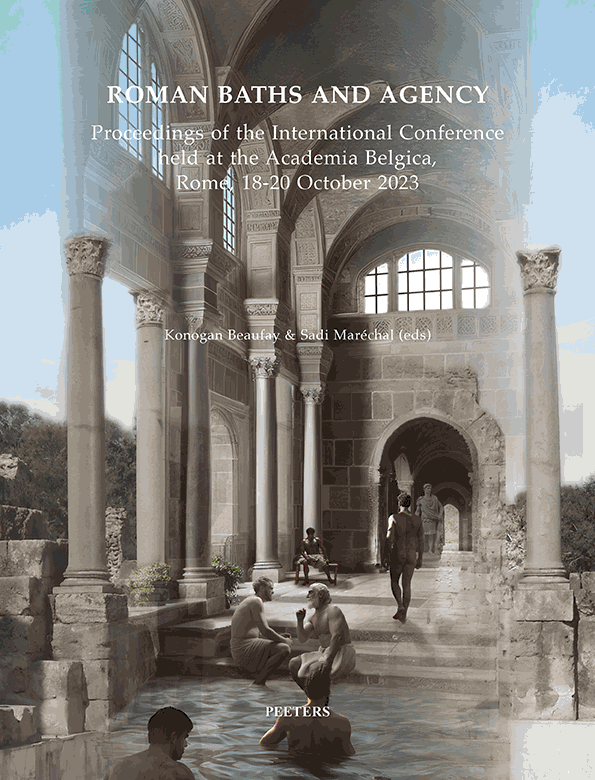
 add to cart
year: 2026
isbn: 9789042958074
pages: X-380 p.
Roman Baths and Agency
Series:
editors:
Summary:
This volume is the fruit of the international conference Roman Baths and Agency. The Human Factor in Designing, Building, Using, Experiencing, and Maintaining Bath Buildings in the Roman Territories, organised by the editors at the Academia Belgica in Rome on 18-20 October 2023.
Through its 26 contributions, it endeavours to restore the human element within the bath building. Few buildings were so central to Roman society as the bath building, which was frequented almost daily by the vast majority of the population, in all corners of the Roman world. More than with architecture, it is with society this volume is concerned, as it attempts to look at the individual and collective choices made, and the actions performed, by the inhabitants of the Roman territories in relation to baths.
The volume is organised around six themes. A first section, entitled ‘Architects, builders, contractors and commissioners’, looks at the individuals responsible for the final appearance of the bath building, through their input in terms of design, funding, and workmanship. The second section, ‘Technology and management of resources’, focuses on the people heating the baths, on the technological devices they operated, and on modern models for calculating the energy output of their work. The third part, ‘Adoption of bathing practices’, looks at two areas of the Roman world and considers what (and who) it took to initiate Roman bathing practices in places that had limited similar traditions. The fourth section, entitled ‘Users and usages’, focuses on the identity of the bathers, on the ways they could circulate in the baths and interact with each other, and on the activities they could perform inside them. The fifth section, ‘Senses and perceptions’, tries to reconstruct the feelings and emotions of the bathing experience, for different types of bathers. For that purpose, it uses evidence from ancient literature and epigrams, and considers the role of natural lighting too. The last section, ‘Small finds in Roman baths’, uses a different type of material evidence, namely strigils, small art items, and coins, to look at the lived experience of bathing.
Through its 26 contributions, it endeavours to restore the human element within the bath building. Few buildings were so central to Roman society as the bath building, which was frequented almost daily by the vast majority of the population, in all corners of the Roman world. More than with architecture, it is with society this volume is concerned, as it attempts to look at the individual and collective choices made, and the actions performed, by the inhabitants of the Roman territories in relation to baths.
The volume is organised around six themes. A first section, entitled ‘Architects, builders, contractors and commissioners’, looks at the individuals responsible for the final appearance of the bath building, through their input in terms of design, funding, and workmanship. The second section, ‘Technology and management of resources’, focuses on the people heating the baths, on the technological devices they operated, and on modern models for calculating the energy output of their work. The third part, ‘Adoption of bathing practices’, looks at two areas of the Roman world and considers what (and who) it took to initiate Roman bathing practices in places that had limited similar traditions. The fourth section, entitled ‘Users and usages’, focuses on the identity of the bathers, on the ways they could circulate in the baths and interact with each other, and on the activities they could perform inside them. The fifth section, ‘Senses and perceptions’, tries to reconstruct the feelings and emotions of the bathing experience, for different types of bathers. For that purpose, it uses evidence from ancient literature and epigrams, and considers the role of natural lighting too. The last section, ‘Small finds in Roman baths’, uses a different type of material evidence, namely strigils, small art items, and coins, to look at the lived experience of bathing.
